
Supporting guide
Angel Portfolio Tracking: How Investors Monitor Startup Investments
Portfolio tracking is the unglamorous half of angel investing. The cheque is a day. The book is a decade. This guide is how individual investors monitor startup holdings after they invest — not how they find deals.
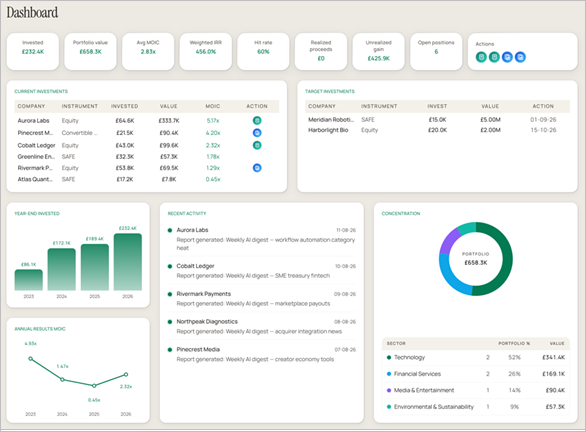
Investech’s dashboard is built as a tracker: capital in, marks, MOIC, IRR, concentration, targets, and an activity feed. Use this page to understand the job; use the product as the ledger.
Canonical category: angel investor portfolio management software · FAQ
What portfolio tracking means
Tracking is a running answer to five questions: what companies are in the book, what instruments you hold, what cash went in and came out, what you currently believe each name is worth, and what is incomplete (certificate, mark, update). If you cannot answer those without opening five apps, you are not tracking — you are reconstructing.
A tracker is not a CRM. Pipeline names you have not funded can sit as targets, but the core object is a holding. Mixing “maybe” and “owned” in one sheet is how open position counts lie.
Common tracking mistakes
- One row per company when you have two instruments (SAFE then equity).
- Updating MOIC in a formula that still includes realised names.
- Storing certificates in email with no link from the company row.
- Never recording the date of a mark, so last year’s round looks current.
- Ignoring follow-on cash so cost basis is wrong when you calculate MOIC.
- Using trading names instead of legal names until the accountant asks.
Metrics investors monitor
Investech’s header metrics are the set most angels actually use: invested, portfolio value, average MOIC, weighted IRR, hit rate, realised proceeds, unrealised gain, open positions. MOIC is “how many times my money” without time. IRR adds time and is only as good as cash-flow dates. Hit rate is a blunt count of names above or below a 1x mark — useful as a hygiene check, not a scoreboard for skill.
Per company, watch instrument type, amount, current value, and MOIC colour. A 5x name next to a 0.45x name is normal in early-stage books. Blended averages hide that. That is why a table of current investments sits under the totals.
Investment timelines
Private holdings do not tick every day. Typical clocks: certificate issuance (weeks to many months after completion), SEIS/EIS holding periods (commonly three years from share issue, confirm current HMRC rules), follow-on windows (days, not months), and exits (years, if at all). Tracking means dating those events so you are not surprised by an Action centre item titled “holding period complete.”
Follow-on rounds
A follow-on is a new capital line on the same company, not an overwrite of the first cheque. If you replace the amount cell, you lose cost history and your MOIC becomes fiction. Record date, amount, instrument, and the new mark from the round. Dilution belongs in the ownership field, not as a comment in Slack.
Founder updates
Updates are evidence, not a newsletter hobby. File them on the company so a later follow-on decision has a trail. Investech’s recent activity and company updates exist so weekly AI digests and founder notes sit next to the holding, not in a separate inbox folder named “portfolio.”
Reporting
Individual angels report to themselves, a spouse, a family office they sit inside, or an accountant. The artefact is a consistent snapshot: totals, names, marks, tax-scheme flags, open actions. See startup portfolio reports for what to measure. Tracking is the feed; reporting is the freeze-frame.
Spreadsheet limitations
Sheets do not attach files, do not nag missing EIS3s, and do not stop two versions of “portfolio_final_v7”. Collaboration with an accountant becomes a mailed XLSX that is stale the next day. Detail: spreadsheets vs software.
How Investech solves it
One dashboard for the book, an investments ledger with instruments, company files for documents and notes, SEIS/EIS status, an Action centre, and reports. Targets stay visible without polluting open positions. That is angel investor portfolio management software, not a marketplace.
FAQ
What is angel portfolio tracking?
- It is the ongoing record of what you own, what you paid, how you mark it, which documents exist, and what you should do next. It is not deal sourcing.
Which metrics should angels monitor?
- At book level: invested, current value, MOIC, IRR, hit rate, realised proceeds, unrealised gain, open positions. At name level: instrument, cost, mark, last update, missing files.
How often should I update marks?
- When you have a signal — a priced round, a write-down policy event, a secondary, or an exit. Weekly private-market mark-to-market is usually noise.
Keep the book in one place
Investech is angel investor portfolio management software — holdings, documents, SEIS/EIS and next actions after you invest.